

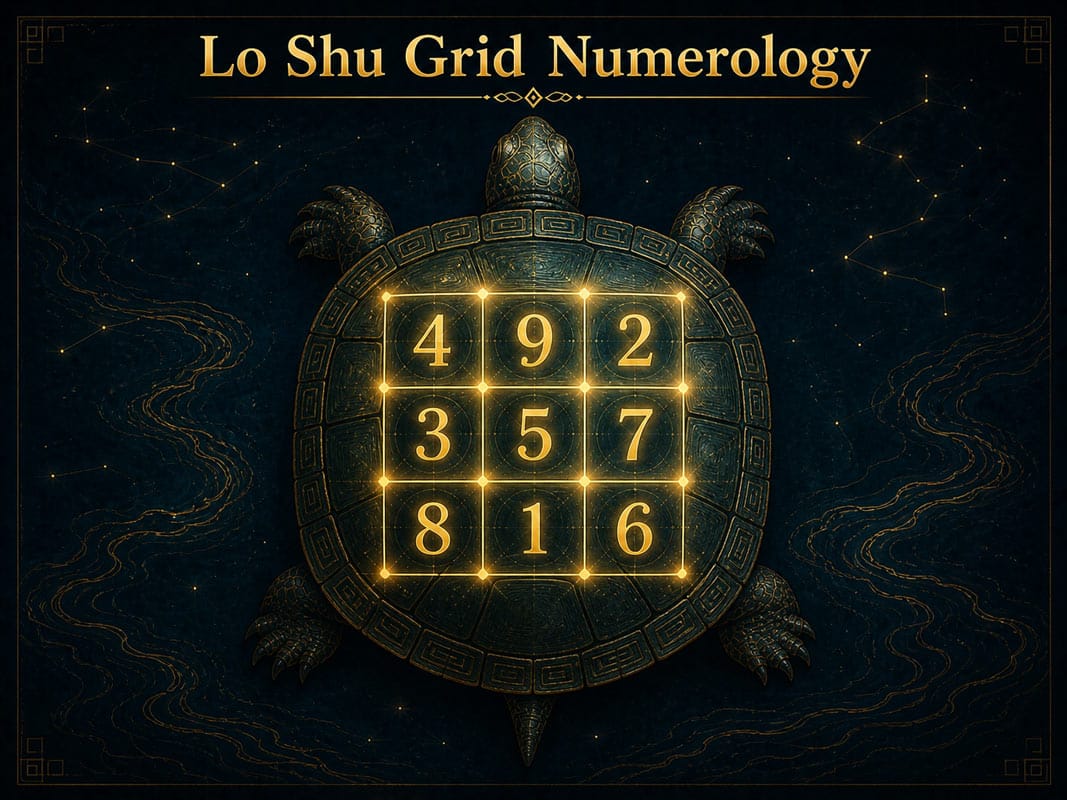
The Lo Shu Grid is the oldest known numerological system in the world. A 3×3 magic square in which the numbers 1 through 9 are arranged so that every row, every column, and both diagonals sum to 15, it has been used for over 4,000 years to map personality, predict life patterns, guide career and relationship decisions, and balance the energetic profile of a person, a business, a home, or a mobile number. This guide covers what the grid is, where it came from, how it is constructed from a date of birth, what each plane and arrow reveals, and how the modern numerologist applies it across the most important predictive domains.
The Origin of the Lo Shu Grid
Approximately 4,000 years ago, during the reign of Emperor Yu of ancient China, the Yellow River (Hwang-Ho) was prone to devastating annual floods. According to legend, while the emperor was searching for a way to control the floods, a divine turtle emerged from the waters of the Lo River bearing a peculiar pattern on its shell, a 3×3 grid of dots representing the numbers 1 to 9. Every row, column, and diagonal of the pattern summed to 15, the same number as the days between a new moon and a full moon. The emperor recognised the pattern as a message from the heavens and named it Lo Shu literally, the writing of the Lo River.
The Lo Shu became the foundation of Chinese numerology, Feng Shui, and the I Ching tradition, eventually travelling along trade routes to India, the Arab world, and Europe. In modern Indian numerology particularly in the Chaldean-Vedic system practised across the country today the Lo Shu Grid sits at the centre of personality analysis, career guidance, and the increasingly important field of mobile number selection.
The Structure of the Grid
The Lo Shu Grid has a fixed structure. The 9 cells are always in the same positions and the numbers always occupy the same cells. What varies between two people is which numbers are present in their personal grid based on their date of birth.
The cell positions are fixed. Position 1 (top-left) is always 4. Position 5 (centre) is always 5. Position 9 (bottom-right) is always 6. The mathematical magic of the square is that no other arrangement of the digits 1 through 9 produces an equal sum across all eight lines, this is the only normal magic square of order three that exists.
Constructing Your Personal Lo Shu Grid
Your personal Lo Shu Grid is built from your full date of birth, with two additional numbers added: your Mulank (the single-digit reduction of the birth day) and your Bhagyank (the single-digit reduction of the entire DOB). Each occurrence of a digit is placed into its fixed cell. Numbers that appear multiple times are stacked. Numbers that do not appear leave an empty cell and those empty cells are where the predictive analysis becomes most informative.
This person’s grid contains 1 (twice), 3, 4, 5, 7, 8 (twice), and 9, but is missing 2 (Moon) and 6 (Venus). The presence patterns and absences in this grid are the foundation of every prediction that follows. For a step-by-step guide on calculating the Mulank and Bhagyank, see the dedicated calculation page.
The Three Horizontal Planes
The three rows of the grid form the most important interpretive planes. Each captures a fundamental dimension of human existence, and the presence or absence of all three numbers in a row reveals whether that dimension is balanced or compromised in the individual.
The Three Vertical Planes
Where the horizontal planes show the dimensions of human existence, the vertical planes show the sequence by which thought becomes outcome. Together, the three vertical planes describe how an individual moves from idea to execution.
The Two Diagonal Yogas: Golden and Silver
The two diagonals of the grid carry the most powerful predictive significance and they are also the rarest configurations in practice. Only an estimated 2 to 3 percent of individuals have either of them complete in their birth grid.
Predictive Applications of the Lo Shu Grid
The Lo Shu Grid is not a single-use diagnostic. The same grid is read against different question types to produce different categories of insight. The major predictive domains are these.
1. Personality and Self-Understanding
The most fundamental application is mapping the individual’s natural temperament. The presence and absence of each digit reveals dominant strengths and structural gaps. A grid with three or more 1s indicates strong leadership and self-direction. A grid missing 5 (Mercury) often corresponds to communication challenges and decision-making hesitation. The patterns are remarkably consistent, clients consistently recognise their own personality in the grid analysis without prompting.
2. Career and Profession Guidance
The dominant numbers in the grid point towards naturally aligned profession types. Strong 1 (Sun) profiles align with leadership, government, and entrepreneurship. Dominant 3 (Jupiter) suits teaching, advisory, and academic work. Multiple 5s (Mercury) favour commerce, communication-heavy professions, and journalism. A complete Practical Plane (8-1-6) is a strong indicator of business success regardless of profession. For a more detailed breakdown of career-specific recommendations, see the dedicated guide on numerology by profession.
3. Health Tendencies and Awareness
Each digit corresponds to specific organ systems and energetic centres in the body. Missing or overloaded numbers can indicate health areas requiring extra attention. Missing 4 (Rahu) is often associated with nervous system sensitivity. Excess 9 (Mars) can correspond to inflammation or pressure-related conditions. Missing 6 (Venus) sometimes corresponds to reproductive and skin tendencies. The Lo Shu Grid is not a diagnostic instrument and never replaces medical advice but it identifies patterns worth monitoring with appropriate professional support.
4. Relationships and Compatibility
Two grids placed side by side reveal compatibility through complementarity. Where one partner has missing numbers, a partner whose grid contains those numbers can balance the gap energetically. The presence of 2 (Moon) in both grids is a positive marriage indicator. The presence of 6 (Venus) supports harmonious domestic life. Conflict patterns often appear when both partners share the same missing planes both feel the same gap simultaneously, with no internal compensation available within the relationship.
5. Mobile Number Selection
This is the most actionable modern application of the Lo Shu Grid. A 10-digit mobile number creates its own Lo Shu Grid based on the digits it contains. The objective is to choose a number whose grid complements the individual’s birth grid supplying digits that are missing from the birth profile rather than reinforcing what is already abundant. This is Layer IV of the six-layer Platinum analysis used by LMNB, see the full methodology for how it integrates with the other layers. A mobile number that fills birth-grid gaps strengthens the energetic profile through the most-used communication channel in modern life. See the case studies page for worked examples of how Lo Shu Grid mismatches in a mobile number compounded existing weaknesses, and how the corrected numbers restored balance.
6. Vastu, Direction, and Spatial Energy
In its original Feng Shui application, each cell of the Lo Shu Grid corresponds to a compass direction. North (1), South (9), East (3), West (7), and the four corners (2, 4, 6, 8). The centre (5) represents the dwelling itself. This mapping is used to harmonise rooms, business premises, and personal workspaces placing functions in the directions that align with the individual’s strong numbers and avoiding direction-based decisions that compound existing weaknesses.
What Missing Numbers Reveal
Missing numbers in the grid are not negative outcomes. They are areas where the individual is energetically learning, growing, or vulnerable to specific patterns. Identifying them allows the patterns to be balanced through complementary mobile numbers, name energization, lifestyle adjustments, and direction-based corrections. The most commonly observed missing-number patterns are summarised below.
Why Expert Interpretation Matters
A Lo Shu Grid in isolation reveals patterns. Genuine prediction comes from integrating the grid with the Mulank, the Bhagyank, the current planetary Dasha (in astro-numerological practice), and the active channels of the individual’s life name, signature, mobile number, account number, and home direction. A practitioner reading only the grid without these complementary inputs will miss the cross-referenced confirmation that distinguishes accurate analysis from generic interpretation. A free Lo Shu Grid calculator is a useful starting point for computing the grid itself, but it cannot substitute for the integrated reading that experienced numerologists provide.
See Your Own Lo Shu Grid
The free LMNB report includes your complete Lo Shu Grid analysis every plane, every missing number, every dominant pattern alongside your Mulank, Bhagyank, and a five-criteria compatibility score for your current mobile number. It is delivered via WhatsApp within 24 to 48 hours at no charge, verified personally by Dr. Amoel Kolte.
Related Guides
Frequently Asked Questions
Can the Lo Shu Grid change over time, or is it fixed for life?
The birth-grid component is fixed for life because it is derived entirely from your date of birth, which does not change. However, your active grid, the digits actually influencing your daily life does change. When you adopt a new mobile number, change your name, alter your signature, or shift your primary residence direction, you introduce or remove digits from your active energetic profile. The birth grid sets the baseline. The active channels you choose around it determine whether you reinforce existing strengths or compensate for missing numbers. This is why a person can fundamentally shift their experience without their date of birth ever changing.
Is the Lo Shu Grid the same as Western numerology?
No. They share some philosophical ground but use entirely different systems. Western numerology (most commonly the Pythagorean system) maps letters of the alphabet to numbers and focuses primarily on name analysis and life path numbers. The Lo Shu Grid is rooted in Chinese tradition and refined in Indian Chaldean-Vedic numerology. It uses date of birth digits placed onto a fixed 3×3 magic square, with each cell carrying a planetary assignment in the Indian adaptation. Both systems can produce useful insights, but they ask different questions and arrive at different recommendations. Practitioners experienced in both will tell you that the Lo Shu Grid offers significantly more analytical depth for prediction and corrective action.
If I have many missing numbers, does that mean my life will be difficult?
Not at all. Missing numbers are not negative outcomes. They are areas the soul has come to develop in this lifetime. Many highly successful individuals have several missing numbers in their birth grid; what distinguishes them is that they have either consciously or instinctively built their lives around channels that compensate for those gaps. A person missing 6 (Venus) may marry a partner whose grid is rich in 6, restoring Venus energy through the relationship. A person missing 5 (Mercury) may build a career that develops Mercury qualities through deliberate practice. The grid identifies what is structurally absent so corrective action becomes targeted rather than guesswork. Missing numbers are diagnostics, not destinies.
What if a number repeats five or six times in my grid? Is that good or bad?
It depends on which number it is. Three occurrences of any digit indicates strong, healthy planetary influence. Four occurrences amplifies that influence further but begins to introduce imbalance. Five or six occurrences typically tips into excess, a strength taken to a problematic extreme. For example, six 1s (Sun) creates extreme self-orientation that can damage relationships. Six 4s (Rahu) creates restlessness, scattered focus, and unconventional behaviour that struggles to find stability. The principle is balance: the most favourable grids have a moderate spread of digits with no single number overwhelmingly dominant. If you have an over-dominant digit, the corrective approach is to introduce complementary digits through your active channels rather than try to suppress the dominant one.
Can two people in the same family have the same Lo Shu Grid?
It is possible but uncommon. Two people would need to share the same date of birth (day, month, and year) to have identical grids. Siblings typically have different grids because their birth dates differ. Parents and children almost always have different grids. Even twins born on the same day will have identical birth grids, but their lives still differ because their names, signatures, mobile numbers, and life choices introduce different digits into their active profiles. The birth grid is the starting hand; the active channels determine how that hand is played. This is also why two friends or business partners with similar grids can have very different outcomes, they have built different active profiles around their shared birth foundation.